 Catalyst Pest Control ServiceCatalyst Pest Control Service
The perimeter holds. Verified, not assumed.
We run pest control service in Peoria, AZ the way the desert actually behaves: the wall line first, the harborage second, the inside only where it earns a treatment. Scorpions live in block-wall weep holes and paver gaps, subterranean termites travel up from soil, and roof rats move along fence tops and palm skirts — so the work is diagnosis, then a written scope, then a perimeter that holds. Call (520) 677-3921, or text a photo of what you found and we will tell you what it is before anybody quotes you anything.
Call (520) 677-3921
Text or call about your pest control service job — a quick photo helps us quote fast.
A firm, all-in price confirmed before we start — no surprises.
On time, done to standard, and tidy when we leave.
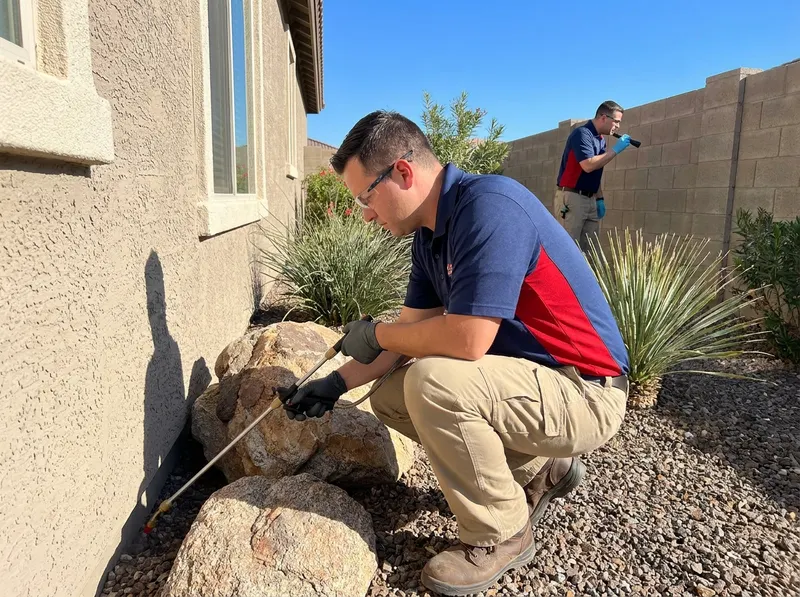
Bark scorpion work in Peoria is a harborage problem before it is a spray problem. We treat the block-wall base and weep holes, paver and flagstone seams, irrigation and valve boxes, pool equipment pads, door sweeps and garage thresholds, then point out the yard features feeding them — river rock beds, stacked pavers, wood piles against stucco. Scorpions do not chew their way in; they walk in through gaps a credit card fits into, which is why door sweeps and thresholds get as much attention as the wall line. Demand climbs from March and peaks May through September, so the first treatment of the year is best booked in late winter. A blacklight walk after dark tells you more about your yard in ten minutes than a month of guessing, and we will tell you what we found rather than handing you an invoice with 'general pest' written on it.
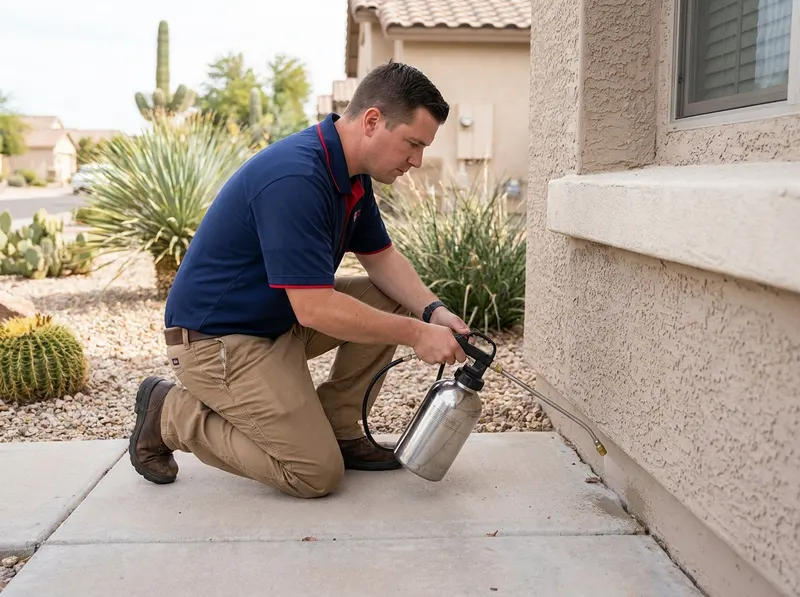
The maintenance program most Peoria homes actually need: a repeating exterior round covering the foundation line, eaves, windows and doors, patio and paver edges, and the wall line where the yard meets the house. Scope is written out in plain English so you know what is included and what is not — no new 'specialty' charge every time a different bug shows up. General pest coverage includes ants, crickets, spiders, earwigs, silverfish and the roach species that live outdoors in the Valley. The reason a recurring cycle matters here is UV and heat: exterior residuals break down faster under Peoria summer sun than they do in a mild climate, so a barrier applied in April is thinner by July unless something renews it. We set the interval to your property and your pest pressure, not to a national schedule.
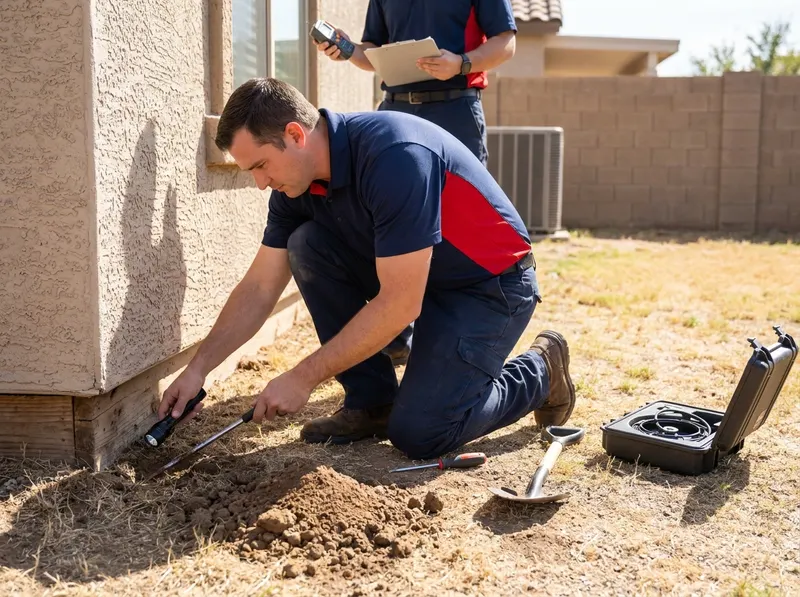
A written inspection of the structure and soil line looking for mud tubes on block walls and stem walls, shelter tubes in garages, damaged baseboards, bath and shower plumbing penetrations, and evidence of prior treatment. Subterranean termites are the species that matters in Maricopa County, and they show themselves after monsoon rain in July through September and again with spring warm-up. If you are selling, refinancing or buying in Westbrook Village, Ventana Lakes or Old Town Peoria, the inspection and report is often the entire job — no treatment needed unless the findings call for it. November through January is the easiest stretch to get an inspection on the calendar, and that is the honest time to handle it rather than the week escrow closes.
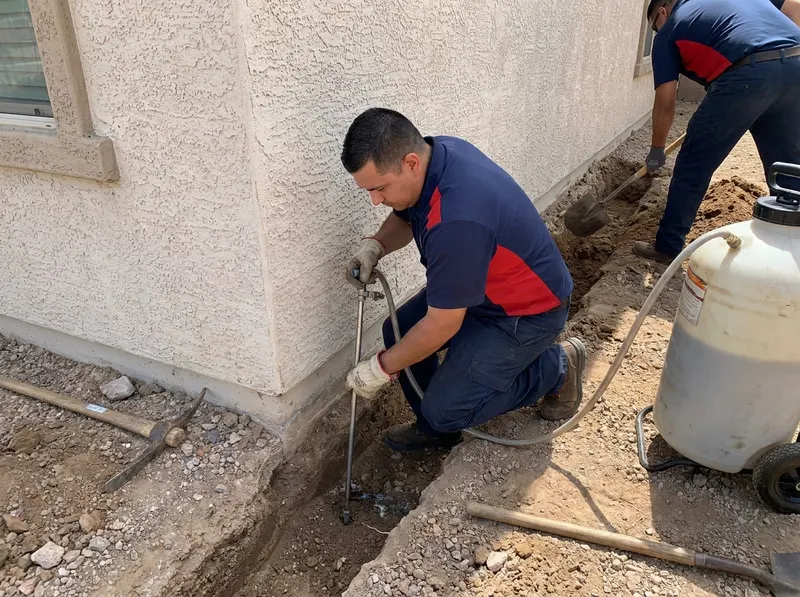
The full-perimeter treatment: soil is trenched along the foundation and around slab penetrations, treated with a labeled termiticide, and backfilled so termites cannot cross the treated band on their way up into the structure. Where hardscape blocks a trench — driveways, walkways, pool decks — the treatment is placed through drilled and patched access points instead. This is the difference between protecting the whole footprint and protecting one wall. It is the right call when the inspection diagram shows activity in more than one location, when tubing appears on an exterior stem wall, or when a home has never had a documented treatment. We show you the diagram and explain where the product went before we call it done.
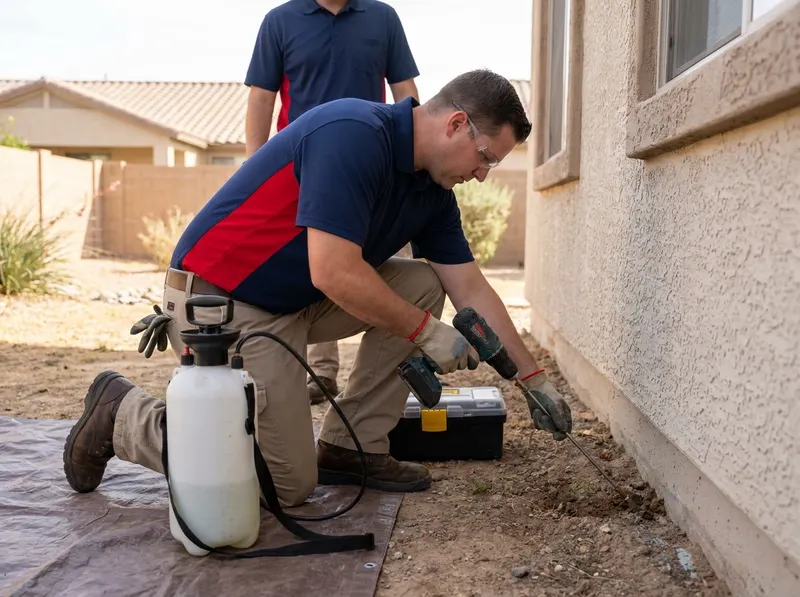
A narrow treatment aimed at one confirmed location — a single bath wall, a garage expansion joint, one section of stem wall with active tubing. Spot work costs a fraction of a full trench and it fits an isolated hit on a home with an otherwise clean inspection. The limitation is honest and worth understanding: a spot treatment protects the area treated, not the rest of the foundation, so if the inspection shows activity at two or three points the math usually favors the full perimeter. We will tell you which one your report supports rather than selling the bigger number by default.
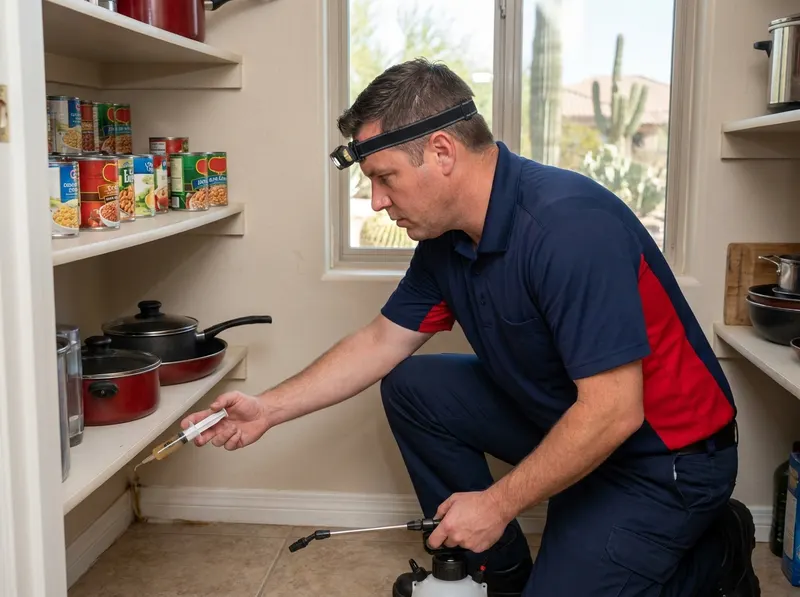
Kitchen and bath work for the roach species that actually breeds indoors: gel bait in hinges, motor housings, cabinet voids and under sinks, crack-and-crevice placement along plumbing lines, monitoring where they travel, plus a required follow-up two to three weeks later. That second visit is not an upsell — it is the visit that catches the nymphs hatching after the first treatment, and skipping it is why roaches 'come back.' Sanitation and moisture drive this pest more than square footage does, so we will point out the dripping angle stop or the cardboard storage behind the fridge instead of pretending product alone solves it. Appliances, apartments and small food-service kitchens in Peoria get the same method at different scale.
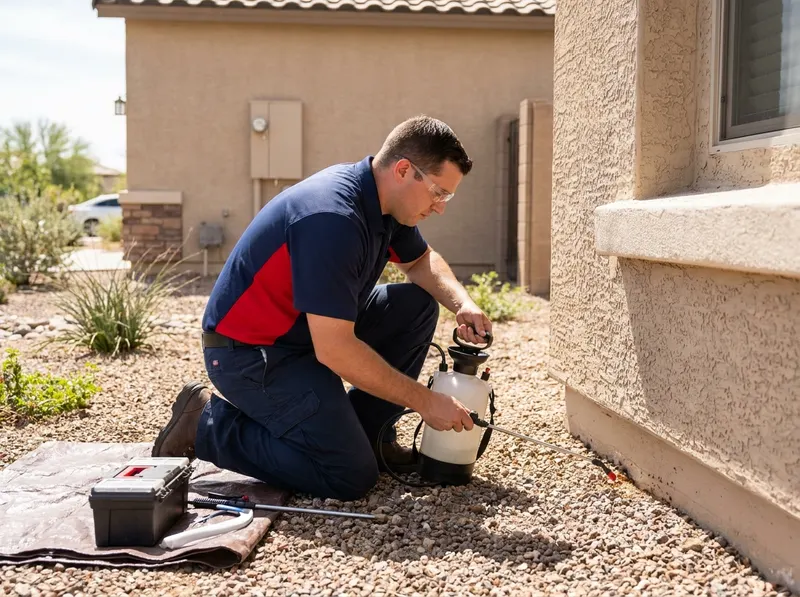
Peoria yards run several ant problems that need different answers. Trailing ants on a kitchen counter get non-repellent gel and liquid bait so foragers carry the material back to the colony; pavement and harvester ants in decomposed granite and along driveway seams get exterior treatment at the nest and along the trail; and irrigation-fed colonies near drip emitters and valve boxes get treated where the moisture is, because that is what put them there. Spraying a trail kills the ants you can see and leaves the colony intact, which is why bait placement and follow-up matter more than volume of product.
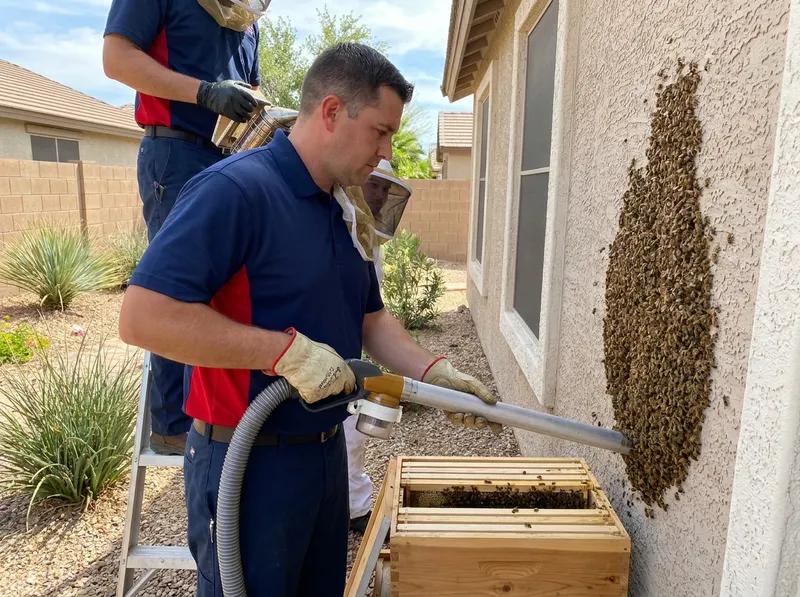
Swarm and hive work, February through May being the heavy season in Peoria. An accessible swarm cluster hanging on a mesquite, palo verde or block wall is a straightforward removal. An established hive inside a wall void, roof tile, water meter box, chimney or irrigation valve box is a different job — it requires opening access to reach comb, and comb left behind attracts robbing bees and stains drywall later. Africanized genetics are the norm in Valley feral colonies, so we treat every established colony as defensive: keep people and pets inside, do not spray it yourself, and do not seal the entrance, which drives bees into the living space. Call (520) 677-3921 and tell us where the entry point is.
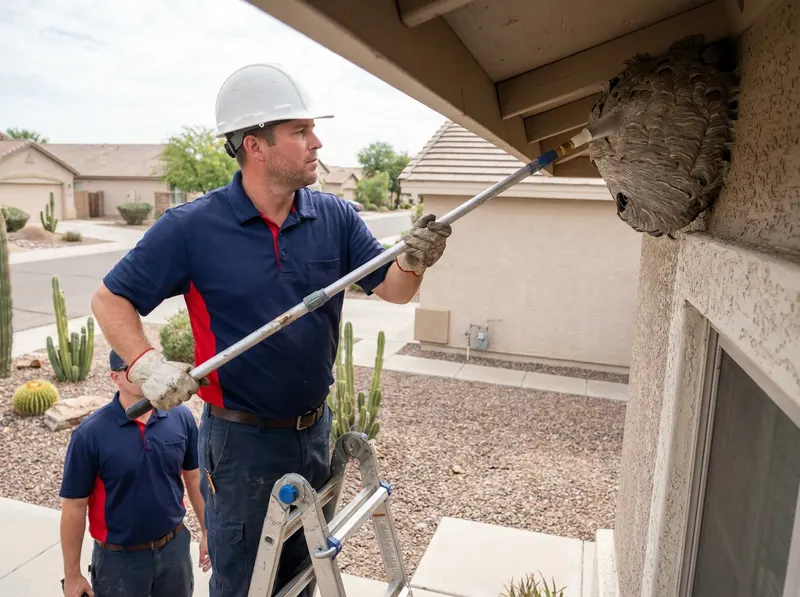
Paper wasp nests under eaves, over garage doors, inside patio ceiling fans, in mailbox voids and behind shutters get knocked down and treated so the nest is not rebuilt in the same spot two weeks later. Mud daubers get handled the same visit. These calls cluster February through May alongside bee season and pick up again in late summer around pool decks and irrigation. If the nest is over a doorway your kids use, say so when you call — a nest at head height near a walkway is a different priority than one on a back fence line.
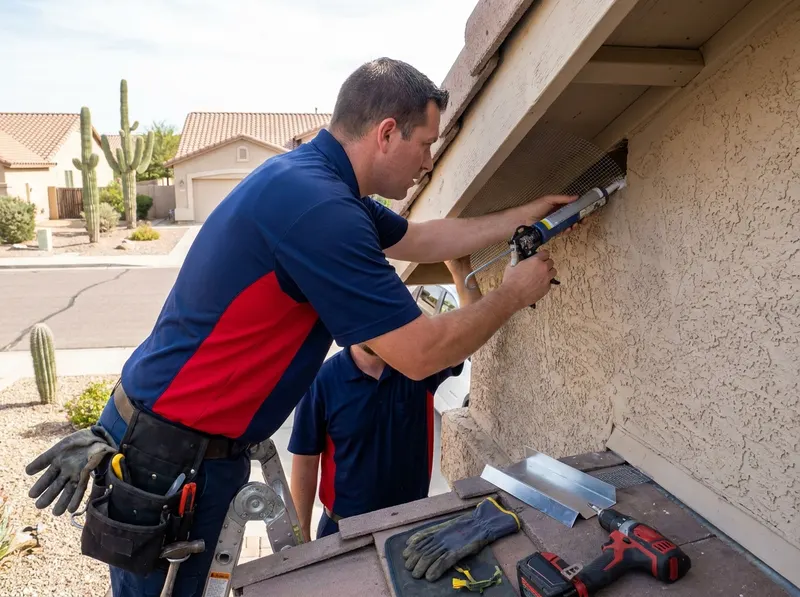
Roof rats travel fence tops, block walls, tree limbs and palm skirts, then enter through roof-tile gaps, plumbing penetrations, attic vents and garage door corners. Activity pushes indoors October through December as overnight lows drop, which makes fall the practical window for this work in Peoria. The service is trapping plus exclusion: identify runways and droppings, set traps where they actually travel, then seal the entry points with material rodents cannot chew through. Trapping without exclusion is a subscription to the same problem — new rats use the same hole. We also flag the outdoor food sources that keep them around, including citrus on the ground, palm fruit, dog food on the patio and unsecured trash.
Scheduled service for Peoria retail shops, offices, salons, restaurants and food-service kitchens: exterior perimeter, dock and dumpster area, interior crack-and-crevice, roach and rodent monitoring, and documentation you can hand an inspector. Visits are scheduled around your hours, and the scope is written so you know what each visit covers. Food-service accounts typically need a tighter interval than retail because organic debris and moisture are constant — monthly is common, and the interval is set by what the monitors show rather than by a sales quota.
Start with what you actually saw, because that decides the treatment — not the package name. If you found one scorpion under a blacklight on the patio and want it to stop being a monthly event, choose a recurring perimeter service: the wall base, weep holes, paver seams, irrigation boxes and door thresholds get treated on a repeating cycle so the barrier is renewed before it breaks down in summer sun. If you are seeing scorpions inside more than once a week, choose the scorpion-focused visit instead — it adds harborage work, dust into block-wall voids and a walk of the yard structures where they hide, and it costs more because it takes two to three times the labor of a routine exterior round. <strong>The trade-off is simple: recurring service is cheaper per visit and keeps pressure low over time, while a single heavy treatment hits harder right now but nothing renews it in six weeks.</strong> If you found mud tubing on a block wall, a slab crack or a garage baseboard, do not buy a general pest plan and hope — that is a different pest with a different license category and a different product. Choose a termite inspection first, then a trench-and-treat if the report calls for it. If you only need documentation for a sale or refinance, an inspection and report is the whole job. If you want the colony's access to the structure cut off, the trench-and-treat is the job: soil is trenched along the foundation, treated, and backfilled so termites cannot cross the treated band. A spot treatment is narrower and cheaper, and it fits an isolated interior hit in one bath wall — the trade-off is that spot work protects one location, while a full perimeter treatment protects the whole footprint. On a typical Peoria single-story, the difference is roughly $400–$800 for spot work versus $1,100–$2,600 for a full trenched perimeter, and the honest way to choose is to read the inspection diagram, not the price. Size and lot matter more than most quotes admit. A 1,600 sq ft home on a small Fletcher Heights or Parkridge lot has maybe 150–200 feet of wall line to treat; a half-acre or larger property in Vistancia, Camino A Lago or Trilogy at Vistancia can run 400 feet or more with detached casitas, pool equipment pads and multiple gates. If your quote is identical to your neighbor's on a lot twice the size, somebody is guessing. Ask what the treated footage is, and ask whether the exterior round includes eaves and window frames or just the ground line. <strong>Do I need interior spraying?</strong> Usually less than you have been told. Ants trailing a kitchen counter and German cockroaches in a rental kitchen do need interior work — gel bait, crack-and-crevice placement, and a follow-up two to three weeks later, because the second visit is what breaks the egg cycle. Scorpions and most spiders are an exterior and exclusion problem, and baseboard spraying inside adds product without adding control. <strong>One-time visit or a plan?</strong> If the problem is a single nest — a wasp nest over a Fletcher Heights garage door, a swarm cluster on a mesquite in Terramar — take the one-time removal and be done. If the problem is the desert itself, a plan fits better; homes backing the Agua Fria River corridor or open desert north of Happy Valley Road get steady pressure and steady re-entry. If you only see pests twice a year, say so and ask for a seasonal schedule instead of a year-round agreement. We would rather write a smaller scope you keep than a big one you cancel. <strong>How fast can somebody get here?</strong> Late spring and early summer are the busiest weeks of the year for general pest service in Peoria, and lead time in that window commonly runs 3–10 days, with recurring-plan customers typically slotted sooner. Winter, roughly December through February, is the slowest stretch and the easiest time to book a full-property inspection or a pre-listing termite report. Tell us on the phone if a scorpion is inside the house or a swarm is active near a door — that information changes where the call sits in the schedule. <strong>Dogs, kids, pool deck?</strong> Products are applied per label directions, we tell you the dry time before anyone goes back out, and we will hand you the product names on request. If you want the lowest-exposure route, ask for bait-and-exclusion-first — slower on knockdown, longer-lasting, and the trade-off is patience.
| Service call | Upfront quote |
Your exact price is confirmed before any work begins.