
Roof Rat and Rodent Exclusion in Peoria, AZ
- Pest Control Service in Peoria
- Scorpion Control
- Recurring Perimeter Pest Service
- Termite Inspection and Report
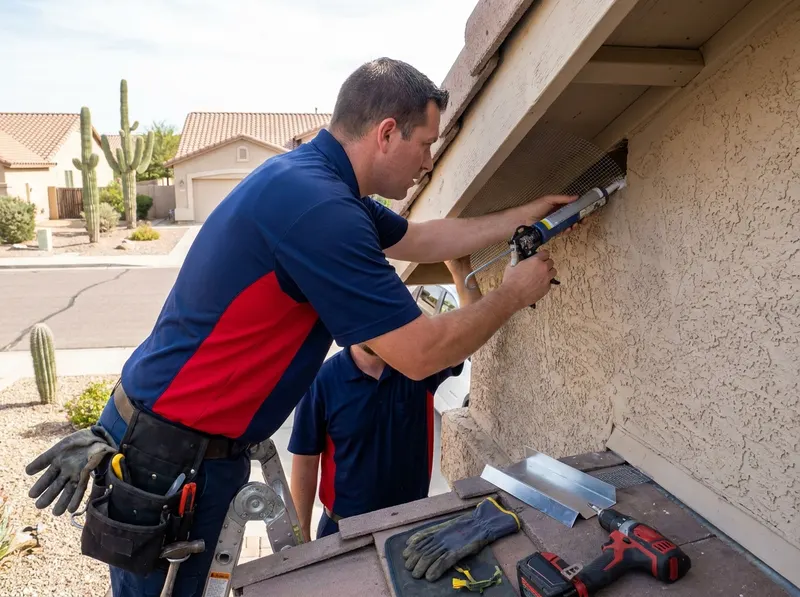
- What's included: a full interior and exterior entry-point inspection (roofline, attic, garage, utility penetrations), sealing of accessible openings with hardware cloth, sheet metal or copper mesh, snap-trap placement in active runways, and a return visit to confirm the traps are quiet and the seals are intact.
- How fast: inspections are typically scheduled within 1-2 business days, and most single-story Peoria homes get the trapping and primary sealing done in the same first visit.
- What it costs: rodent work in Peoria starts at a $250 minimum, with most whole-home exclusion projects landing in the $450-$1,600 range depending on roof type, house size and how many openings need to be closed.
- What we take: cash, check, and major credit and debit cards.
- How to book: call or text (520) 677-3921 for a free on-site rodent inspection; the exact price is confirmed in writing before any sealing begins.
Roof rats are the rodent Peoria homeowners deal with most, and they behave differently than a ground-dwelling mouse. They travel above head height — along block walls, fence lines, irrigation lines, palm trunks and overhanging citrus limbs — then enter at the roofline rather than the slab. That is why the older, heavily landscaped pockets of Peoria see them first: mature citrus and fig in Old Town Peoria, dense oleander and ficus screening in Westbrook Village, the shade canopies around Ventana Lakes, and any yard close to the Agua Fria River corridor, where the riparian cover along the wash gives rodents a permanent staging area before they push into surrounding streets. Activity climbs in fall and winter as nights cool and irrigation drops off, which is exactly when we get calls about scratching over a bedroom ceiling.
Exclusion versus baiting is the real decision, and it comes down to whether you want the population reduced or the entry closed. <strong>Bait stations placed without sealing the structure treat the symptom — new rodents follow the same scent trails to the same opening within weeks.</strong> Exclusion costs more up front and takes longer, because someone has to physically get on the roof, into the attic and behind the water heater to find every gap. The trade-off is durability: once a tile-roof edge is fitted with rodent-proof material and the vent screens are replaced with quarter-inch mesh, that route is finished. We also do not use rodenticide inside living spaces or attics where an animal can die in a wall void — trapping gives us the carcass, and the carcass is the proof the work is done.
House type changes the scope, and Peoria has two very different building stocks. Newer stucco-and-tile homes in Vistancia, Trilogy at Vistancia, Camino A Lago and Sierra Verde usually fail at the same places: unsealed bird stops along the tile courses, unscreened O'Hagin roof vents, and the gap where the A/C refrigerant line and low-voltage wiring pass through the wall. Older 1980s-90s construction in Fletcher Heights, Terramar and Parkridge tends to fail at worn garage door bottom seals, corroded gable louvers, cut-in sewer vents, and sagging soffit returns. On single-story homes with clean roof access the sealing work is often a one-day job. Two-story homes, heavy tile, or an attic already carrying droppings and nesting material take longer and may need sanitation before insulation is disturbed.
What we tell every Peoria homeowner up front: the yard is part of the fix. Trim tree limbs back three to four feet from the roof, keep fallen citrus picked up, skirt palm trees, and pull bird seed and dog food off the patio at night. Rodents follow the highway before they find the door. We document the openings we find, seal what is accessible, name anything that needs a roofer or handyman, and come back to verify. That is the standard on every rodent job — <strong>the perimeter holds, verified, not assumed.</strong> No annual contract is required for rodent exclusion; it is a defined project with an end point, and you are free to add ongoing perimeter service afterward or not.
Call (520) 677-3921Roof Rat and Rodent Exclusion pricing in Peoria
| Rodent inspection with initial trapping and minor sealing (service minimum) | $250 |
| Single-story exclusion, limited entry points (garage seal, vent screens, utility penetrations) | $350 - $650 |
| Whole-home tile roof exclusion (bird stops, roof vents, roofline gaps) | $650 - $1,600 |
| Two-story or multi-elevation home, extensive openings | $1,200 - $2,800 |
| Attic droppings cleanup and sanitation | $350 - $900 |
| Follow-up trapping visit after primary sealing | From $250 |
| Damaged insulation removal and replacement (per affected area) | quoted after attic inspection |
Exact price confirmed free on-site before any work.
Roof Rat and Rodent Exclusion — questions, answered
How do I know I have roof rats and not mice in my Peoria home?
Roof rats in Peoria leave capsule-shaped droppings about half an inch long, greasy rub marks along roof framing and attic joists, and gnaw damage on citrus fruit left hanging in the tree. Noise pattern is the other tell: roof rats run at ceiling level after dusk, while mice are usually heard low, in walls and under cabinets. We identify the species during the inspection because it determines trap size, placement height and which openings matter.
Why is exclusion necessary if you can just put out bait in my Peoria attic?
Exclusion is necessary because Peoria's rodent pressure is continuous — the citrus, irrigation and wash corridors keep producing new animals, so an unsealed opening simply refills. Bait can reduce numbers but it does nothing to the entry point, and a rodent that dies inside a wall void or attic becomes an odor and fly problem. Sealing the structure and trapping the residents is the version of this work that actually ends.
Are the traps and materials safe around dogs, kids and a pool deck in Peoria?
Yes — the rodent method we favor in Peoria homes is mechanical, not chemical. Snap traps are placed inside tamper-resistant housings or in attic and void spaces pets and children cannot reach, and the sealing materials are hardware cloth, sheet metal, copper mesh and sealant, all inert once installed. Nothing is broadcast on patios, turf or pool decking as part of an exclusion job.
Will one visit solve a rodent problem at my house in Peoria?
Most Peoria rodent jobs need the primary visit plus at least one verification visit. The first visit covers inspection, trap placement and sealing of accessible openings; the return visit confirms traps are no longer producing, removes captures, and checks that no new gnaw entry has been opened. Attics with heavy contamination or homes needing a roofer's help take longer, and we say so at the inspection rather than after.
Do you handle rodents in Peoria commercial kitchens and small retail spaces?
Yes. Small restaurants, cafes and retail suites around Peoria — including centers near the Peoria Sports Complex and the Old Town corridor — get the same exclusion approach adapted for inspection compliance: door sweeps and dock seals, sealed utility chases, mapped trap placement with service documentation, and written findings you can hand to a Maricopa County inspector.