
Honey Bee Removal in Peoria, AZ
- Pest Control Service in Peoria
- Scorpion Control
- Recurring Perimeter Pest Service
- Termite Inspection and Report
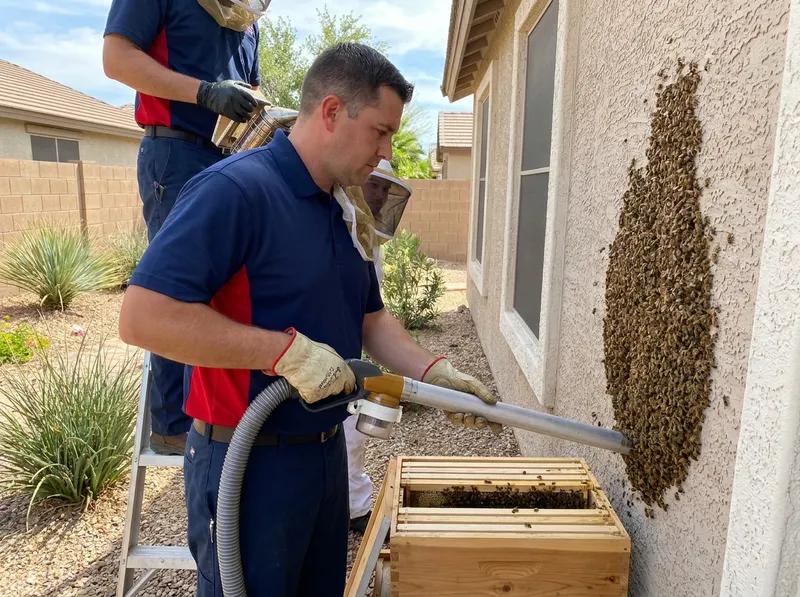
- What's included: on-site identification of swarm versus established colony, treatment or removal of the bees, location of the entry point, and a written scope of what was opened, treated and sealed.
- How fast: bee calls are triaged ahead of routine service because stinging insects near a door, pool deck or play area are an immediate hazard — same-day or next-day scheduling in most of Peoria.
- What it costs: $250 minimum for an accessible exposed swarm; established wall, eave or roof-tile colonies with comb typically run $450-$1,500+ depending on access and how much comb and honey must come out.
- What we take: the bees, the accessible comb and honey when the void is opened, and the debris from the removal area.
- How to book: call (520) 677-3921, describe where the bees are entering and how long they have been there, and we schedule a free on-site look to confirm the exact price before any work starts.
A swarm and a colony look similar from the driveway and behave nothing alike. A swarm is a football-to-basketball-sized cluster of bees resting on a palo verde branch, a block wall cap, a patio post or a mailbox while scouts look for a permanent cavity. It has no comb, no honey and often moves on within one to three days. An established colony has comb, brood and stored honey inside a void — the classic Peoria hiding spots are block-wall weep holes, gaps under concrete roof tile on the tile-roof homes throughout Vistancia and Trilogy at Vistancia, stucco cracks and older eave gaps in Westbrook Village and Old Town Peoria, water-meter and irrigation valve boxes, and hollow saguaro or mesquite near the Agua Fria River corridor. If bees are streaming in and out of one fixed hole in a steady line, and have been for more than a couple of weeks, you have a colony, not a swarm.
That distinction drives the decision. <strong>An exposed, accessible swarm is the cheapest and simplest job</strong> because nothing has to be opened. A colony inside a wall is where the honest trade-off lives: treating the bees at the entry point alone is less expensive, but it leaves comb, wax and honey sealed in the cavity. In Peoria's summer heat that abandoned honey softens, can seep through drywall or stucco, and reliably draws robbing bees the following spring plus ants and cockroaches from inside the wall. <strong>Opening the void and removing the comb costs more and creates a patch to repair, but it removes the reason the next swarm smells that wall and stops there.</strong> We will tell you which one your situation actually calls for and what each option leaves behind — that conversation happens on-site, before a price is set.
Assume any feral honey bee colony in Maricopa County is defensive. Africanized genetics are widespread in feral bee populations across the Phoenix metro, and temperament cannot be judged from ten feet away, so treatment distance, timing and protective equipment are handled accordingly. Practical steps while you wait: keep people, dogs and pool deck traffic well away from the flight path, close windows on that side of the house, do not spray the cluster with a hose or a can of wasp spray, and <strong>do not plug the entry hole</strong> — sealing a live colony's only exit pushes bees through interior wall gaps and light fixtures into the house. If bees are inside a wall against a bedroom, say so when you call.
Timing in Peoria is predictable enough to plan around. <strong>Swarm calls concentrate from roughly February through May</strong>, when citrus, mesquite and palo verde bloom and colonies split — that is when clusters show up on backyard walls in Fletcher Heights, Sierra Verde, Terramar and Camino A Lago, and near the water features and lakeside lots in Ventana Lakes. A second, smaller wave follows monsoon moisture. Standing water is the other magnet: homes near the retention basins and turf at Rio Vista Community Park, Pioneer Community Park and Paloma Community Park, or with a drip line that runs long in July, host more foraging traffic — which is normal and not a colony. Foragers on a flowering shrub or a pool edge do not need treatment. A fixed entry hole with a line of traffic does. <strong>Live relocation is only realistic with an exposed, accessible swarm and no established comb</strong>; colonies already built into a Peoria wall void or roof tile are handled as removals, and we say that plainly rather than promising a beekeeper rescue that the access does not allow. Bee work is one-time by nature — there is no reason to sign a long contract for a spring swarm. Call (520) 677-3921 and we will look at it first. The perimeter holds. Verified, not assumed.
Call (520) 677-3921Honey Bee Removal pricing in Peoria
| Exposed, accessible swarm cluster (wall cap, tree branch, patio post) | $250 - $400 |
| Colony in irrigation, valve or water-meter box | $275 - $475 |
| Colony under concrete roof tile or in a tile-roof eave | $450 - $850 |
| Block-wall or stucco void colony — treatment and entry-point seal, comb left in place | $400 - $700 |
| Wall/void colony with cut-out, comb and honey removal, and cleanout | $650 - $1,500+ |
| Second-story or lift/ladder access above standard reach | $250–$300 |
| Free on-site identification and written scope before work | $0 |
Exact price confirmed free on-site before any work.
Honey Bee Removal — questions, answered
How fast can you get to a bee call in Peoria?
Bee calls in Peoria are triaged ahead of routine service, with same-day or next-day scheduling in most cases. Bees at a front door, garage, pool deck or backyard play area near a school pickup route get priority, because the hazard is active rather than seasonal. Call (520) 677-3921 and describe the location and the flight path.
Is the swarm on my Peoria block wall the same problem as bees inside the wall?
No. A swarm hanging on a Peoria block wall or palo verde branch is a temporary resting cluster with no comb and often leaves within one to three days. Bees entering a single fixed hole in the wall, eave or roof tile day after day are an established colony with comb and honey inside the void, which is a larger and more expensive job.
What does honey bee removal cost in Peoria?
Honey bee removal in Peoria starts at a $250 minimum for an accessible exposed swarm, and established colonies inside walls, eaves or roof tile typically fall between $450 and $1,500+ depending on access and how much comb must be removed. Every figure is a ballpark — the exact price is confirmed during a free on-site look before work begins.
Do you relocate bees alive in Peoria instead of treating them?
Live relocation is only practical in Peoria when the bees are an exposed, accessible swarm with no comb built yet. Colonies already established inside a Peoria wall void, roof tile or irrigation box are handled as removals, because feral colonies in Maricopa County are treated as defensive and the cavity access rarely allows an intact hive transfer.
Should I seal the hole where bees are entering my Peoria house?
Do not seal a live entry hole on a Peoria home. Blocking the only exit drives bees deeper into the wall and often into the interior through light fixtures, outlets and baseboard gaps. Keep people and pets away from the flight path, leave the opening alone, and have the colony treated or removed first — sealing is the last step, not the first.